
The Essential Kit for Whitewater Kayaking
Having the best whitewater kayaking experience means having the best whitewater kayaking gear.
If you’ve already shopped about for your whitewater clothing and equipment, you’ll know that the possibilities are endless. Each time you think you have the lot, there’s a new material, different size or upgraded safety feature to consider.
To make sure you have everything you need for ultimate whitewater kayaking, we’ve researched and put together your complete kit for beginners right through to experts.
Tick off each item as you go to make sure you’re safe, comfy and performing at your best the next time you head to the water.

Choosing the best whitewater kayak
The first part of your kit that you need to consider is, of course, your whitewater kayak itself. (If you already have one, just skip to the ‘Kit’ section).
Whitewater kayaking at its best is an extreme sport that demands skill, knowledge and experience. Exhilarating and dramatic, it’s one of those watersports that everyone wishes they could dare themselves to do.
The best whitewater kayak for you depends on whether you’re just starting out in the sport, or you’re at an advanced level and need an upgrade. There’s also water condition and weight/length to think about, but we’ll go over everything here.
You have about four whitewater kayaks to choose from: playboats, longboats, creek boats, and river runners.
River runner; if you’re a beginner, we suggest going for a river running kayak. They usually give you the best control for rolling and maneuvering and are the most versatile for having fun as you speed downriver.
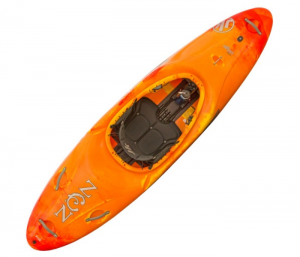
Creek boats; these are the largest whitewater kayaks. Great for charging over big rapids, taking sharp turns, resurfacing quickly, and keeping control over waterfalls; creek boats are built for extreme conditions. If you want full-throttle whitewater kayaking, they’re ideal, but their rounded bottoms can make the boat feel slightly unstable to some paddlers.
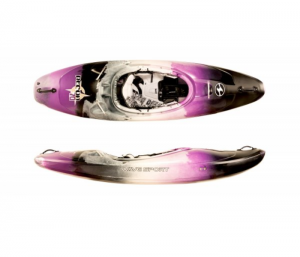
Playboats; built for surfing waves and performing all kinds of tricks. Playboats are the shortest of our four kayaks. Extremely fun and perfect for adding a twist to an ordinary whitewater session, playboats require a lot of technique and you might get wet often and easily.
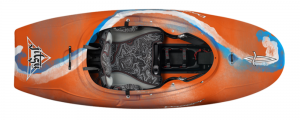
Longboats; these are very fast and are basically longer river runners. They’re the best whitewater kayak for keen racers who want excellent maneuverability.
You’ve probably noticed that there’s a wide range of kayak sizes available, too. Try to choose a boat that puts you in the middle of its given weight range capacity to ensure maximum comfort and control, and remember your kit will add about another 10 pounds at least!
Kit
Now to put together all the essentials you need together to help you paddle faster, safer and smarter.
Helmet
A helmet should top your list when it comes to whitewater kayaking gear. As you can imagine, whitewater kayaking throws up a lot of unexpected twists, turns and drops — that’s why we love it. There’ll be times when you fall out of your kayak and in rushing, rocky rivers, you’re going to want decent head protection. Just make sure you choose a helmet that features:
- High-impact resistance
- Non-absorbent materials
- Easy and quick drying and drainage
- Snug fitting that covers your temple area and nape of your neck
- Strap for securing on your head
- Brims for keeping sun and spray out of your eyes
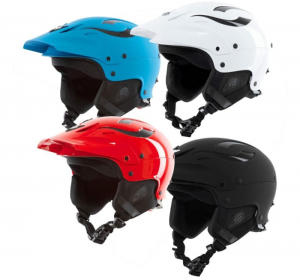
There are plenty of quality helmet options available, although, we love the whitewater rocker helmets from Sweet Protection, which you can get with a shatter-proof visor and in a range of bright colours.
Personal floatation device
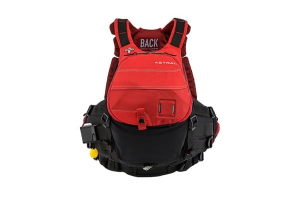
A personal floatation device (PFD), such as a buoyancy aid, is just as important as a quality helmet when it comes to whitewater kayaking gear. If you’re pulled under water, a PFD can save your life. Unlike a life jacket — which is designed to keep you afloat on your back — a buoyancy aid helps you stay above the surface while giving you a good range of motion so you can swim to safety. Like a helmet, this should be a snug fit, but not too tight that it’s uncomfortable.
Paddle
Steering, stopping and propelling your kayak along the water is the objective of your kayaking paddle. This is a critical part of your kayaking kit, and needs to be strong, durable and comfortable to hold.
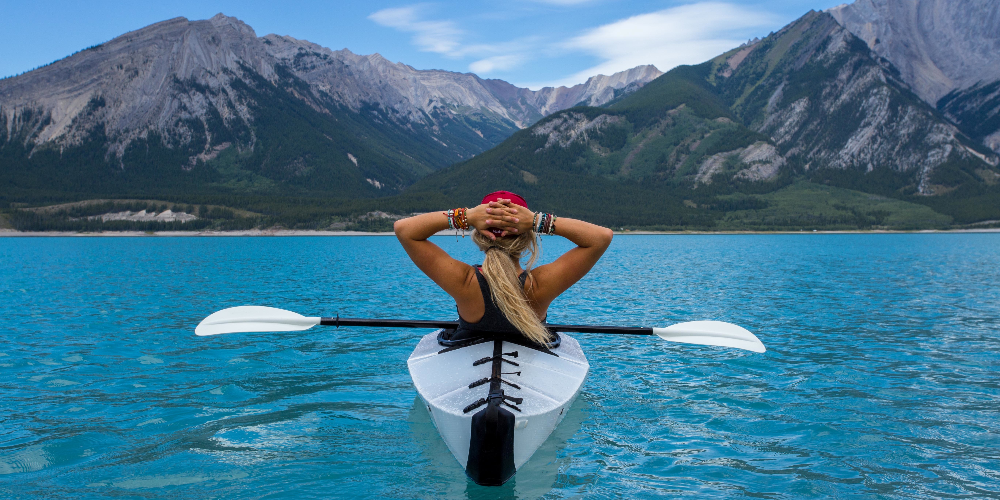
There are five main parts of paddle-buying you need to consider: blade shape and material; shaft length and shape; and feather angle.
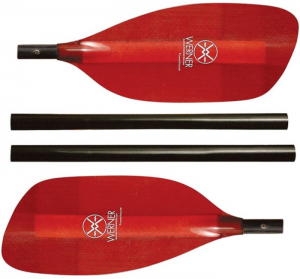
Blade shape; whitewater paddles are more streamlined than recreational paddles and larger than sea kayaking paddles. Out of all the varieties, we advise you avoid collapsible paddles, as they’re less robust. If you want to develop your stroke manoeuvres, go for responsive freestyle blades.
Blade material; you’ll be holding your paddle in front of you for a long time, so you want a blade that is as light as possible to avoid getting tired. Basic paddles are made from plastic blades and aluminium shafts, which are fine for recreational paddling. However, we suggest something sturdier for more intense whitewater kayaking.
Fibreglass: performs much better than plastic, will usually last you double the time, and isn’t too expensive. For the lightest, strongest (and most expensive) option; go for carbon glass and foam core paddles.
Shaft length; try a shorter paddle if you’re planning on playboat and freestyle kayaking, and a longer one for river running and creek boating. Basically, shorter kayak paddles are easier to hold and better at maintaining a straight line, while longer paddles give you more turning leverage and allow for a ‘fuller’ stroke that helps acceleration.
It’s important you get the right fit for comfort and movability. To test; place you paddle vertically against a wall, then stand next to it and reach your arm above your head. If it’s the right size, you should just be able to curl your fingers over the top of it. If you can get your whole hand over the top or can’t reach the blade all; it’s the wrong length for you.
Shaft shape; if you’ve already been looking, you’ve probably seen that there’s a mix of bent and straight shaft styles. Bent shaft paddles affect how you hold the paddle. The design means it’s angled inwards, which gives a more ergonomic grip and natural resting stance. These are especially good for long sessions on the water or if your muscles become sore easily.
Feather angle; this is the angle that one blade is offset from the other and is designed to combat wind resistance. Years ago, it was normal to have a 90° angle offset. But today, 30° and 45° angle offset designs, such as these red and blue paddles from Palm, are common.
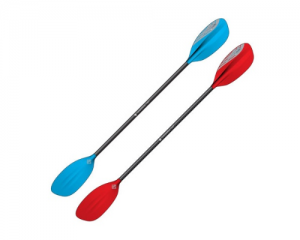
Most paddlers interested in playboating and freestyle whitewater kayaking prefer no offset, which makes strokes and rolling easier. Feathered paddles are good if you’re paddling into strong wind, although they can feel awkward for beginners and higher feather angles might put extra strain on your wrists.
Spray deck
A few waves and you might as well have not bothered with the boat. The best whitewater kayak kit always has a whitewater spray deck, which is worn around your waist and attached to your kayak’s cockpit rim. This gives you a watertight seal that makes sure the inside of your boat is safe and dry from waves.
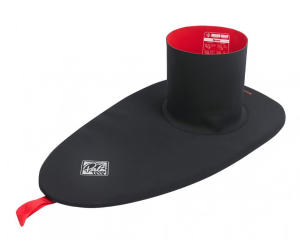
A high-quality spray deck choice for your whitewater kayaking kit is a neoprene spray deck with high-tension bungee. These designs are easy to stretch and attach, very reliable during vigorous movement, abrasion resistant, and exceptionally secure.
Getting the right spray deck fit all depends on your whitewater kayak brand. Each manufacturer has its own size chart, and you have to take into account both the circumference of the cockpit and size of your waist.
Whitewater clothing
Whitewater clothing is crucial to how well you perform, how much you develop and long you can stay on the water.
Thermals
Starting from your bottom layer and working out, you should never forget your thermal tops and pants when it comes to whitewater clothing. They’re an essential heat barrier between your body and the cold climate, and the right material even helps wick away moisture from your skin to keep you comfy and dry. Not cotton, though, so avoid that fabric!
Drysuit
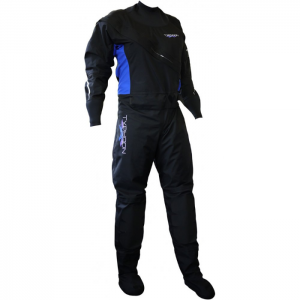
Although quite new on the whitewater clothing scene, drysuits are ideal for paddling. This durable all-in-one design features integrated socks and latex seals around the neck, ankles and wrists, which help to regulate your temperature, prevent water from reaching your skin and stop cold spots around your back and waist.
Cag
Boost your chances of staying warm, dry and happy on the water with a cag. A cag is a lightweight style of jacket that acts as a protective shell between you and the unpredictable weather — an essential quality of whitewater clothing. Pulled on over your head, it seals at your neck, waist and wrists, and can come with various layers for added insulation. You can choose from latex, neoprene and adjustable seals, while the bright colours help make you easy to spot if you’re paddling in early morning or evening.
Footwear
All you want from whitewater footwear is a shoe that grips well on wet surfaces. And a pair of thermal socks are nice for cold days off land. Getting in and out of your kayak means standing — and even carrying your heavy kayak — on damp ground. Imagine coming out of your kayak in the water and stepping on jagged rocks or a slippery waterbed. Not having the right whitewater kayaking shoes is really dangerous, so you should try and choose a pair with a solid sole, excellent grip, comfortable fit, and good drainage features, whether they’re neoprene boots or trainer-style shoes.
Gloves and pogies
Making sure you have the best whitewater kayak kit means making sure every part of you is performing at its best. You need full use of your hands to maintain momentum, steer your kayak and keep yourself from falling in the water. If you’re sitting inside a cockpit, one of the main parts of your body exposed to wind, cold and water is your hands. The best addition to your whitewater clothing selection is neoprene gloves.
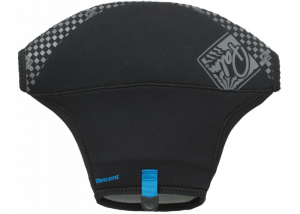
Thickness of whitewater kayaking gloves varies, but as long as you choose neoprene you have a water resistant, insulating, breathable, lightweight, and cushioning glove that keeps your hands protected from all kinds of dangers and obstructions. If you prefer the mitten style and want an unobstructed hold on your paddle, try a pogie like this one from Palm, instead. These slide onto your paddle shaft and cover the top of your hands while allowing your palms to grip.
Safety accessories
The best whitewater kayaking equipment always includes safety essentials.
Throw lines
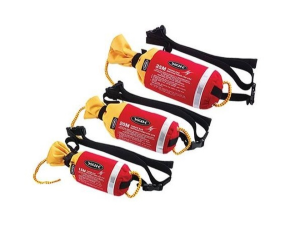
In a nutshell, it’s a rope in a bag. But throw lines are a must for whitewater kayakers. If someone is in danger, all you do is hold one end of the rope and throw the bag to the person in trouble. The momentum of your throw and collective weight of the bag means the rope unwinds in the air and can travel much further towards the person in trouble.
River knife
You might also want to throw a handy river knife into you whitewater gear kitbag. A river knife can help you escape if you get tangled in a fishing line or throw rope.
Airbag
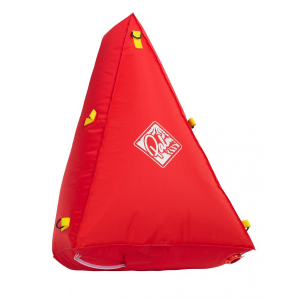
Putting airbags in the bow and stern of your boat is a huge help if you get into trouble. As we’ve said, whitewater kayaking is full of unexpected moments. Without airbags, your boat will fill with water rapidly and it can be much harder to get it out of a strong current and to empty it at the shore.
Extras
Just one more thing…
Roofrack
This whole guide is pointless without the final entry to our whitewater kayaking gear. To actually get your kayak to the shore, you’re going to need a strong and sturdy roof rack. You’ll have to get a different style and size depending on your vehicle’s make, model and year, so check which one suits you and make sure your whitewater equipment arrives safely.
For more important information about having fun and staying safe when paddling, check out our range of whitewater kayaking books.
Comments are closed here.